Proudly serving Tucson, Oro Valley, Marana, Catalina Foothills, Casas Adobes, Sahuarita & surrounding areasCall or Text 24/7: 520-569-2093

24/7 Emergency Tree Removal & Hazardous Limb Cleanup in Tucson, AZ

Tucson Tree Service Co. provides emergency tree service in Tucson, AZ, for trees threatening people, homes, vehicles, or access. The crew handles emergency tree removal, storm damage cleanup, hazardous limb removal, and debris cleanup across the metro area. Once the immediate hazard is controlled, available follow-up care includes tree trimming, pruning, stump grinding, palm trimming, cactus removal, arborist consultation, and tree planting. Every recommendation starts with the tree's condition and what it is threatening.

Tucson's July through September monsoon season can bring microburst winds, flash flooding, lightning, and sudden root saturation. Mesquite, palo verde, eucalyptus, and other desert trees may split, lean, or drop heavy limbs overnight. Licensed and insured crews assess structural risk, disease signs, root failure, access, and surrounding property before planning the work.

Call immediately when a tree has fallen on a structure or vehicle, blocks the only safe exit, or is tangled in electrical lines. written estimate are provided for scheduled work and emergency calls whenever possible, and response moves forward as weather and site conditions allow.

Tucson Tree Service Co. provides emergency tree service throughout Tucson, Oro Valley, Marana, Sahuarita, and greater Pima County.

★ ★ ★ ★ ★4.9/5 Average Rating · 20+ Years of Experience · Thousands of Customers Helped · Licensed & Insured · Residential & Commercial

Emergency Tree Risks & Response

What Counts as an Emergency Tree Service Call?

Emergency tree removal addresses an immediate risk to life, property, or access. A dead tree leaning toward a bedroom after a windstorm is an emergency; an overgrown tree due for seasonal pruning is scheduled maintenance.

Tucson averages roughly 12 inches of rain a year, much of it arriving in violent monsoon bursts when wind gusts can exceed 50-60 mph. A tree that appears stable in April may become hazardous in August when sudden saturation softens caliche soil and destabilizes its root plate.

Cracked trunks, exposed roots, sudden leaning, and large dead limbs hanging over occupied areas signal active failure. Trees on power lines, trees blocking a single point of property access, and partially fallen trees that remain upright warrant a prompt call.

Benefits of a Risk-Based Emergency Response

A structured response focuses first on what the tree is threatening, then matches the crew, equipment, and removal method to that hazard. This limits avoidable movement around unstable wood and keeps cleanup decisions tied to the actual site.

  • Dispatcher triage based on tree size, location, and the immediate threat
  • Bucket trucks, cranes, or rigging selected for the access and canopy hazard
  • Controlled sectional lowering near roofs, fences, walls, pools, and sheds
  • Tree hazard assessment before cutting begins
  • Corrective pruning when a storm-damaged tree can be retained
  • Debris hauling with optional below-grade stump grinding
  • written estimate whenever the situation allows
  • Around-the-clock storm calls with dispatch as conditions permit
Urgent Tree Care

Emergency Tree Services

Emergency tree work ranges from stabilizing a broken limb to dismantling an entire failed tree. The right service depends on whether the danger comes from storm damage, dead wood, root failure, confined access, or contact with nearby structures and lines.

emergency Tree Response

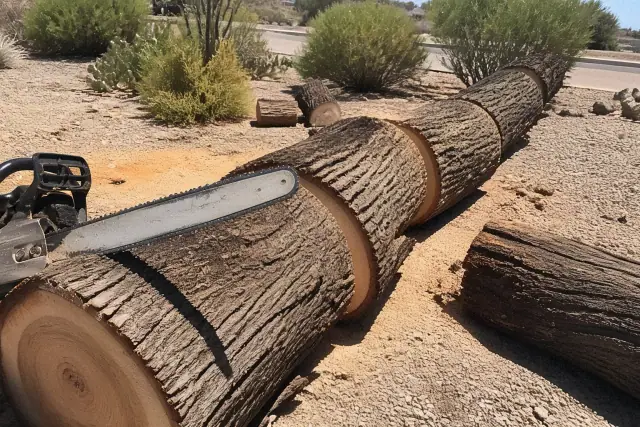
A chainsaw cutting a fallen tree trunk into logs in a Tucson, AZ desert landscape with visible sawdust.

During active weather events, calls are accepted around the clock. Dispatch collects the tree's size, location, and what it is threatening, then sends a crew as conditions allow with equipment suited to the reported hazard.

Request Estimate

Storm Damage Tree Removal

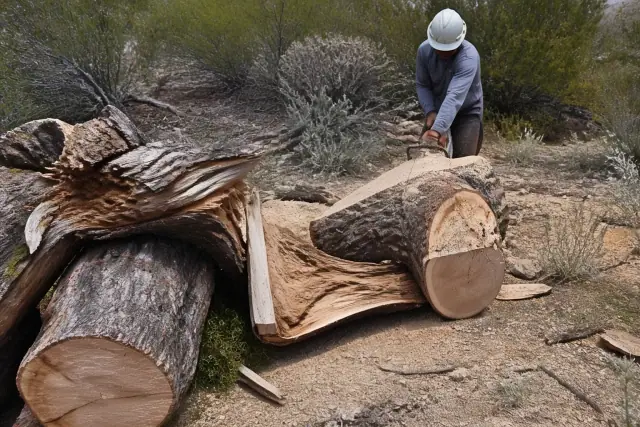
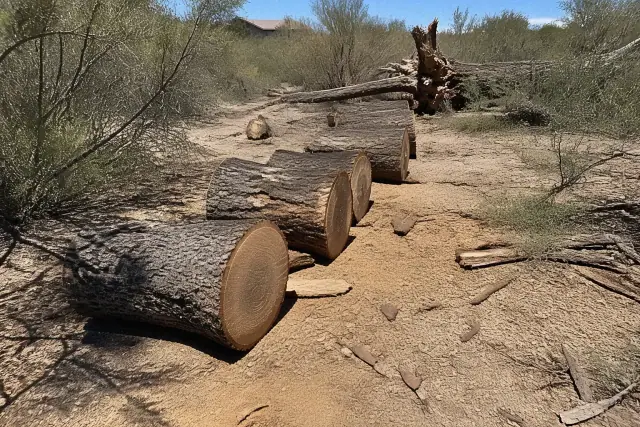
A large downed tree trunk being cut into logs on rocky desert ground in Tucson, AZ.

Microbursts, lightning, and sudden rainfall can break crowns or overturn trees in saturated caliche and decomposed granite. The crew checks the root crown, lean angle, and canopy to decide whether full removal or corrective pruning is appropriate.

Request Estimate

Fallen Tree and Debris Cleanup

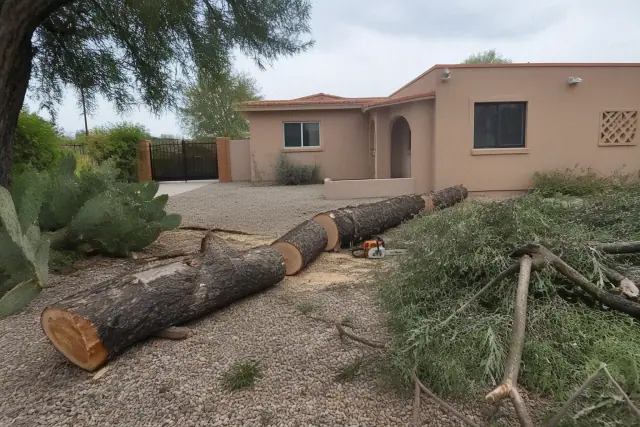
Fallen tree trunk being cut into logs during debris cleanup at a home in Tucson, AZ.

After a fallen tree is cleared, crews haul the cut material and leave the site graded and clean. Remaining stumps can be ground below grade on request, making this a complete post-storm cleanup option.

Request Estimate

Dangerous Tree Removal

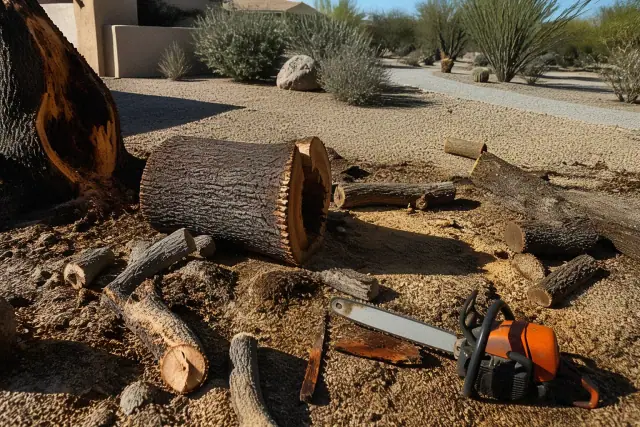
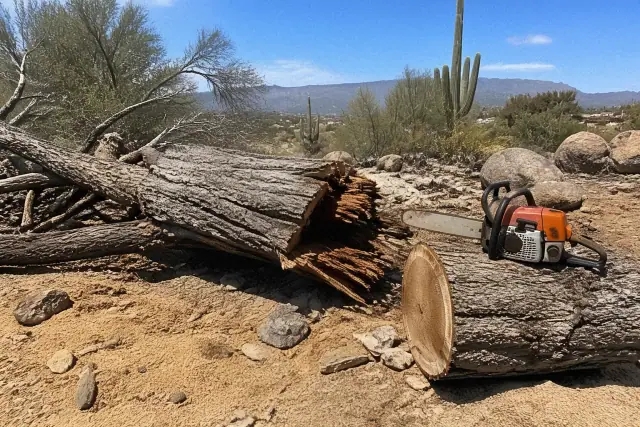
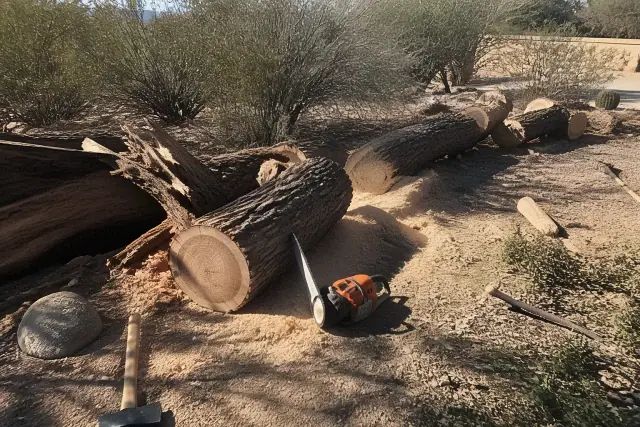
A chainsaw resting near a large sectioned tree trunk in a Tucson, AZ, desert yard with gravel landscaping.

Trees leaning against roofs, wedged between structures, or split into multiple trunks need a sequenced removal plan. Directional felling, crane assistance, or piece-by-piece rigging is chosen according to clearance and wood stability.

Request Estimate

Dead and Dying Tree Removal

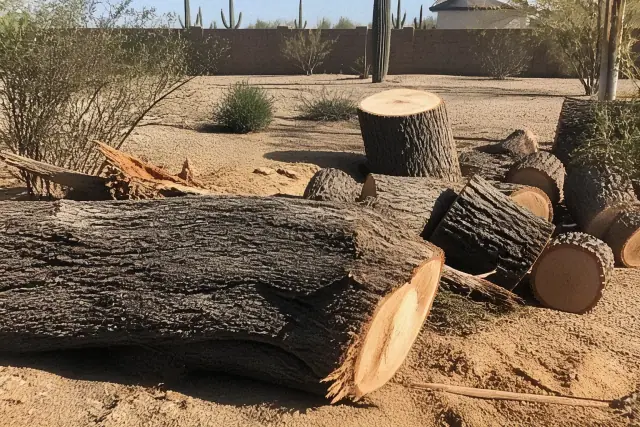
A large tree trunk cut into logs with sawdust on the ground in the desert landscape of Tucson, AZ.

Drought, bark beetle activity, and dry heat can leave mesquite, ash, and palo verde wood brittle and unpredictable. Directional felling or rope-controlled sectional removal keeps compromised pieces away from nearby property.

Request Estimate

Hazardous Limb Removal

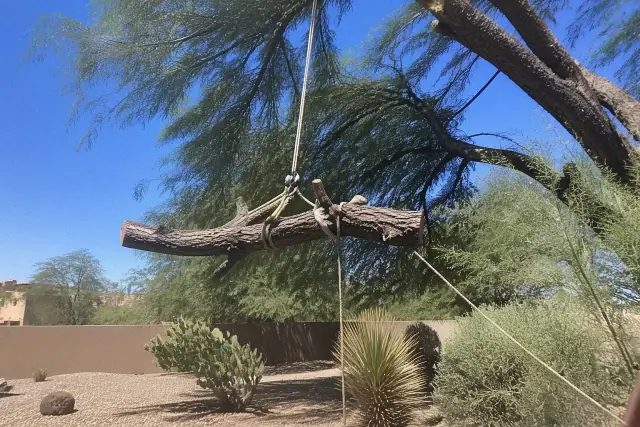
Heavy tree branch lowered by ropes during hazardous limb removal in a Tucson, AZ desert landscape.

A cracked limb over a driveway can shift within hours as wind load changes and the exposed wood dries. Bucket-truck access or controlled rope lowering removes elevated branches without dropping them onto structures or access routes below.

Request Estimate
Response Options

Emergency Tree Removal Approaches

Not every urgent call requires the same response. The crew separates active-danger situations from scheduled care, then plans around storm damage, limited access, electrical hazards, and the possibility of saving the tree.

A large tree trunk cut into logs at a jobsite with saguaros in the background in Tucson, AZ.

Active-Danger Emergencies

Immediate response is for trees already affecting life safety, occupied property, vehicles, or the only usable access route. These conditions should be described clearly to dispatch so the reported threat drives crew preparation.

  • A tree or heavy limb on a home, carport, or other structure
  • A fallen tree resting on a vehicle
  • The only route into or out of the property is blocked
  • A partially fallen tree remains upright and unstable
  • Branches or trunks are tangled in electrical lines
Request Estimate
A chainsaw cutting a large fallen tree trunk into logs in a dry desert landscape in Tucson, AZ.

Post-Monsoon Tree Hazards

Storm-damaged trees may hide root or canopy failures that are not obvious from the ground. Assessment determines whether controlled removal is necessary or whether corrective pruning can retain a structurally viable tree.

  • Microburst wind damage to mesquite, palo verde, and eucalyptus
  • Lightning-split trunks and crowns
  • Flash-flood saturation around the root plate
  • Hanging, broken, or twisted canopy limbs
  • Lean-angle changes after heavy rain
Request Estimate
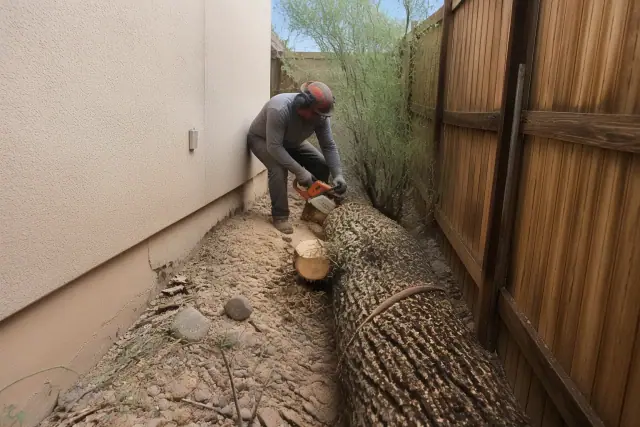
Worker using a chainsaw to cut a fallen tree in a confined space between a residential wall and fence in Tucson, AZ.

Confined-Space Removals

Block walls, pools, sheds, roofs, and neighboring structures can eliminate room for open felling. In these spaces, the tree is dismantled in planned sections so cut wood can be controlled throughout the removal.

  • Directional felling for open yards with adequate clearance
  • Sectional rigging for trees between structures
  • Crane-assisted removal on tight urban lots
  • Bucket-truck access for elevated canopy work
  • Rope lowering near fences, hardscape, and neighboring property
Request Estimate
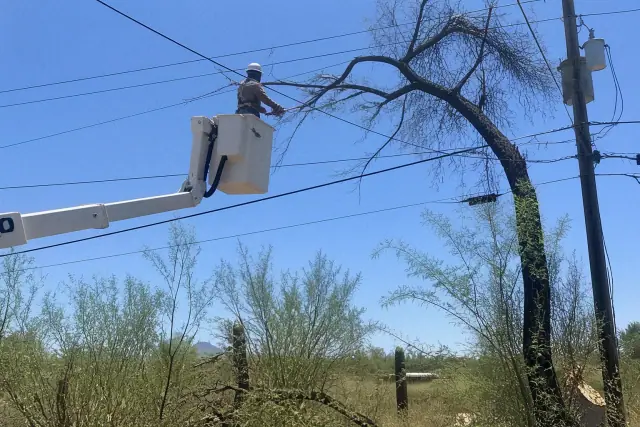
Tree branches tangled in power lines above Sonoran desert plants at a job site in Tucson, AZ.

Power-Line Tree Hazards

A tree touching or growing into live lines requires specialized protocol and may require utility coordination before cutting begins. Do not approach the tree or attempt to move branches while electrical contact is possible.

  • Report whether the tree is on service lines or larger utility lines
  • Keep people away from the tree and surrounding ground
  • Wait for required utility line-clearance coordination
  • Plan cuts around the line, roof, and access constraints
  • Use controlled rigging instead of an uncontrolled drop
Request Estimate
Crew cutting a fallen tree trunk into logs for emergency cleanup in a Tucson, AZ desert landscape.

Emergency Work vs. Scheduled Care

Urgency is based on active danger, not simply the presence of a tree defect. A large dead limb that can be safely avoided until morning may fit standard next-day scheduling, while a similar limb over the only driveway may require immediate action.

  • Overgrown trees without active failure belong on a routine pruning schedule
  • Species and growth rate may support pruning every one to three years
  • Major corrective work may be staged over one or two visits
  • ANSI A300 pruning avoids removing an excessive share of live canopy at once
  • DIY tree work is especially risky; OSHA data attributes more than 100 deaths annually nationwide to tree-related work
Request Estimate
Finding Your Right Fit

Choosing the Right Emergency Tree Approach

A sound plan begins with structural risk and site access rather than a one-size-fits-all cutting method. Standards-led assessment, equipment matched to the hazard, and insured local crews help turn that evaluation into a controlled removal or corrective-pruning plan.

Standards-Led Hazard Assessment

Species, trunk diameter, root-plate condition, structure proximity, and canopy health all inform whether removal or corrective pruning is appropriate.

Job-Specific Removal Equipment

Bucket trucks support canopy work over structures, while cranes and specialized rigging handle tight urban lots and unpredictable wood. Stump grinders can take a remaining stump below grade in one pass when site access and the stump allow it.

Licensed and Insured Crews

Tucson Tree Service Co. carries the licensing and liability insurance Arizona homeowners should require before tree work begins. Local experience with desert species, brittle wood, caliche footing, and Tucson property layouts informs safer site planning.

What Sets Us Apart

Why Choose Us for Emergency Tree Service?

Experience ranges from century-old mesquites on historic Barrio Viejo lots to commercial palm rows along Speedway Boulevard. That local context is paired with clear hazard triage, an itemized estimate whenever possible, and a removal method selected around the tree, access, and surrounding property.

Request an Estimate

Cracked or Split Trunks

A fresh trunk crack, split crown, or separated multi-trunk union can shift without warning under changing wind load. If the defect leans toward a home, driveway, fence, or occupied area, keep clear and request an immediate assessment.

Sudden Lean and Lifted Roots

A new lean after rain, exposed roots, or soil lifting on one side of the trunk can indicate root-plate failure. Sudden monsoon saturation is especially important in poorly draining caliche and decomposed granite.

Hanging or Broken Limbs

Large dead or broken limbs suspended in the canopy can fall as the wood dries or wind direction changes. The urgency rises when the limb hangs over a roof, driveway, walkway, vehicle, or neighboring property.

Trees on Structures or Vehicles

A tree resting on a roof, carport, shed, or vehicle may still be carrying stored weight through broken limbs and unstable contact points. Controlled sectional removal helps avoid shifting that load onto the damaged property.

Trees Near Power Lines

Trees tangled in electrical lines require immediate caution and may need coordination with Tucson Electric Power or another utility provider before removal. Stay away from the tree and do not attempt DIY cutting around live power.

Dead or Dying Trees

Bark sloughing in sheets, no spring leaf-out, fungal growth at the base, and limbs that snap without bending are signs of decline. A standing dead tree near a home, driveway, or line becomes a greater liability every month it remains in place.

How it works

Our Emergency Tree Process

Emergency work follows a risk-first sequence from the initial call through cleanup. Each step narrows the hazard, confirms access and equipment needs, and controls how unstable wood is cut and moved.

01.

Dispatcher Hazard Triage

Dispatch asks about tree size, location, visible damage, access, and what the tree is threatening. Those details help distinguish immediate danger from a next-day or scheduled service call.

02.

On-Site Risk Assessment

The crew inspects the root crown, lean angle, trunk unions, and canopy for hanging or broken limbs before starting a chainsaw. Proximity to people, structures, vehicles, walls, pools, and lines shapes the risk assessment.

03.

Removal Plan and Estimate

Assessment determines whether the tree requires full removal or can be saved through corrective pruning. Whenever possible, the crew provides a free, itemized estimate before cutting begins.

04.

Site and Utility Safety

The work zone is planned around access, occupied areas, adjacent property, and electrical hazards. When canopy or trunks involve service lines, required utility coordination happens before unsafe cutting proceeds.

05.

Controlled Cutting and Removal

Crews use directional felling where clearance permits and sectional rigging, bucket trucks, or crane assistance where it does not. The crew lead sequences the work before the first cut so each piece has a controlled path.

06.

Cleanup and Stump Options

Cut material is cleared and hauled away, and the site is left graded and clean. If requested and included in the estimate, the remaining stump can be ground below grade.

Help When It Matters

Request Emergency
Tree
Service

Describe the tree, visible damage, access, and what is at risk. Tucson Tree Service Co. can triage the call, explain the appropriate response, and provide an estimate whenever conditions allow.

Emergency Tree Help

Emergency Tree Service FAQs

These answers cover urgent tree conditions, Tucson removal costs, storm cleanup, power-line safety, preventative pruning, and what to report when calling for help.

Call About Your Tree

Emergency tree removal covers immediate danger to people, structures, vehicles, or essential access. Examples include a tree on a home, a blocked exit route, a trunk resting on power lines, or a cracked tree leaning toward occupied property; an overgrown tree needing routine pruning is not the same level of urgency.

Arizona does not have one comprehensive statute called tree law, but property owners are generally responsible for trees on their land and may face liability for a hazard they knew or should have known about. A neighbor may generally trim encroaching branches or roots at the property line without entering the adjoining property, while removal of native plants such as a saguaro may involve Arizona Department of Agriculture or Pima County protections; confirm boundaries and applicable protections before removal.

A 40-foot tree removal in Tucson typically falls between $1,800 and $4,200. Species, trunk diameter, root-system size, access, proximity to structures or power lines, and whether stump grinding is included all affect the final estimate.

Free or reduced-cost removal is not a guaranteed standing program, but seniors on a fixed income may find help through local nonprofits, utility vegetation-management programs, or right-of-way maintenance when a qualifying hazard affects public or utility infrastructure. Eligibility depends on the tree, its location, and current program availability.

Tucson Tree Service Co. accepts emergency calls around the clock during active weather events. Crews move as weather, road access, electrical hazards, and site conditions allow, so dispatch will first ask what happened and what the tree is threatening.

Call the same day for a cracked or split trunk, roots lifting from the soil, sudden leaning after wind or rain, or a large dead limb hanging over a home, driveway, or fence line. Call immediately when the tree is on a structure, blocks the only exit, remains partially fallen and unstable, or involves electrical lines.

Stay away from the tree, surrounding ground, and any fallen line, and do not attempt to cut or move branches yourself. Tree removal may need to wait for coordination with the utility provider and proper line-clearance procedures.

Sometimes. An assessment of the root crown, lean angle, trunk structure, and broken canopy determines whether the tree needs full removal or can remain with corrective pruning; the decision depends on structural stability, not appearance alone.

Most residential storm cleanup jobs in Tucson wrap up within a single day, depending on tree size and access. A tree on a structure, work near lines, confined-space rigging, or extensive debris can change the schedule.

Small trees under 30 feet typically run $150 to $450, while medium trees between 30 and 60 feet generally cost more depending on trunk diameter and canopy spread. Standard trimming and pruning runs around $120 to $150 per hour for a two-man crew, while true after-hours emergency work is closer to $250 per hour; height, species, access, structures, lines, root size, and stump grinding all shape the final quote.

Stump grinding is available on request and is usually quoted separately from tree removal. When included, the remaining stump can be ground below grade after the fallen tree and debris are cleared.

A consistent schedule is generally every one to three years, depending on species and growth rate. Trees with years of deadwood or unbalanced growth may need corrective work staged over one or two visits rather than excessive canopy removal in a single session.

Describe the tree's approximate size, location, visible damage, access conditions, and what it is threatening. Mention any contact with a structure, vehicle, exit route, neighboring property, or utility line so dispatch can prepare for the specific hazard.