Proudly serving Tucson, Oro Valley, Marana, Catalina Foothills, Casas Adobes, Sahuarita & surrounding areasCall or Text 24/7: 520-569-2093

Storm Damage Cleanup & Fallen Tree Removal in Tucson, AZ

Tucson Tree Service Co. provides storm damage cleanup and emergency tree service for homes, commercial sites, and multi-property communities across Tucson, Arizona. We remove fallen trees, section hazardous limbs, haul branches and debris, grind stumps, and assess standing trees that may be saved through corrective pruning. Our crews also handle storm-damaged palms and cacti, then support replacement tree planting when cleanup leaves a gap in shade or screening. From June through September, Tucson monsoons, microbursts, and haboobs can drive 60 mph gusts into shallow-rooted desert trees.

Cracked limbs, split trunks, and loosened root plates can shift again within hours after saturated soil and strong wind destabilize a tree. Mesquite, palo verde, ironwood, eucalyptus, and Aleppo pine each fail differently around carports, roofs, fences, vehicles, and block walls. A trained hazard sweep identifies energized lines, spring-loaded limbs, and weight under tension before cutting begins. Prompt assessment helps protect the property and avoids the unpredictable risks of do-it-yourself removal.

Crews evaluate whether a damaged tree should be removed or may recover, then plan equipment and access around the condition of the tree and property. Bucket trucks, rigging, chippers, and stump grinders may be used for dense desert hardwoods and Tucson's caliche-heavy soil.

Tucson Tree Service Co. provides storm damage cleanup in Tucson, Oro Valley, Marana, Sahuarita, and greater Pima County.

★ ★ ★ ★ ★4.9/5 Average Rating · 20+ Years of Experience · Thousands of Customers Helped · Licensed & Insured · Residential & Commercial

Storm Damage Response and Recovery

What Does Storm Damage Cleanup Include?

Storm damage cleanup starts by separating immediate hazards from work that can wait. The initial assessment checks power-line contact, unstable root plates, split trunks, hanging branches, and any load resting on a roof, fence, vehicle, or driveway.

After the hazard is controlled, crews section trunks and limbs from the top down, use rigging to manage the drop zone, chip brush when access allows, and load larger wood for hauling. Cleanup includes broken branches around the tree, debris in gutters, shredded palm fronds, and cactus pads scattered across the property.

Final restoration can include raking and blowing the site, filling disturbed soil where a root plate lifted, grinding a stump on request, and identifying roots that could interfere with replanting. A final walk-through confirms that the ground is safe and the agreed cleanup is complete.

Benefits of Professional Storm Cleanup

Professional cleanup controls the mechanical energy stored in leaning trunks and bound limbs while moving debris without causing additional damage. It also gives property owners a documented assessment of what was removed, what was saved, and what should be monitored before the next wind event.

  • Hazards are identified before chainsaws or rigging are put to work.
  • Controlled sectioning protects roofs, fences, vehicles, sheds, and block walls.
  • Rigging and pulleys manage heavy wood near tight drop zones.
  • Brush chipping and hauling remove more than the main trunk.
  • Arborist review distinguishes salvageable trees from unsafe failures.
  • Corrective pruning preserves sound canopy without over-pruning.
  • Stump grinding and soil cleanup restore a usable ground surface.
  • Before-and-after photos and itemized invoices support insurance discussions.
Storm Recovery Services

Complete Tucson Storm Cleanup Services

Each response is built around the tree's condition, the load it places on nearby structures, and what the property needs after removal. Services range from an urgent hazard assessment to controlled removal, debris hauling, corrective pruning, stump grinding, and landscape recovery.

emergency Hazard Assessment

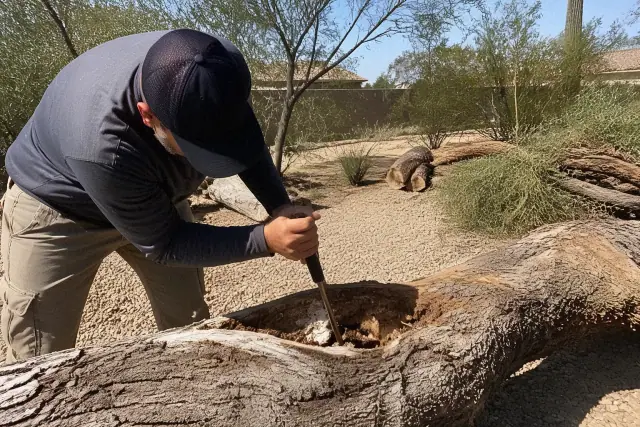
Contractor inspecting a downed tree for storm damage and rot in a Tucson, AZ landscape.

Emergency calls begin with a site sweep for energized lines, split trunks, unstable root plates, and limbs under tension. Trees leaning toward structures, blocking access, or resting on power lines are prioritized ahead of lower-risk debris cleanup.

Request Estimate

Controlled Fallen Tree Removal

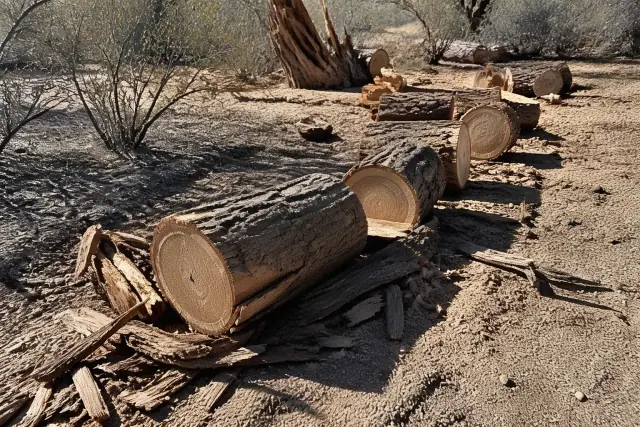
A large tree trunk sectioned into logs on the ground after storm damage in Tucson, AZ, surrounded by dry desert brush.

Crews evaluate lean, weight distribution, tension, compression, and anything supporting the trunk before making a cut. Top-down sectioning, cranes, come-alongs, and controlled lowering can redirect the load away from roofs and fence lines.

Request Estimate

Branch, Brush, and Debris Hauling

Workers removing brush and debris from a downed tree in a Tucson, AZ desert yard.

Broken limbs, shredded fronds, cactus pads, brush, and trunk sections are cleared as part of the storm job. Material is chipped on site when access allows, loaded onto trucks, and taken to approved green-waste or disposal facilities.

Request Estimate

Corrective Pruning for Damaged Trees

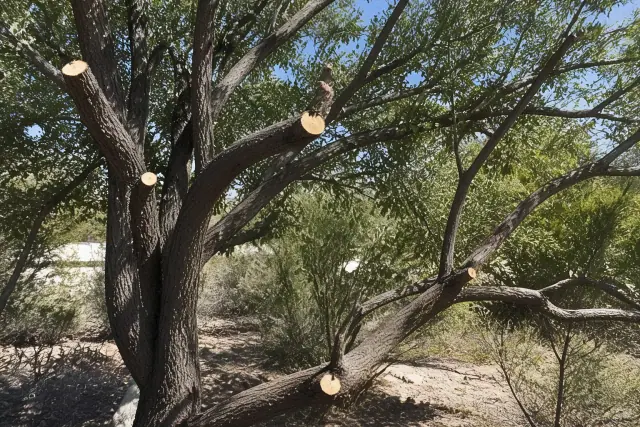
Close-up of precise pruning cuts on tree branches for storm damage cleanup in Tucson, AZ.

Trees with recoverable structure receive pruning that removes torn or hanging limbs, reduces weight on damaged scaffold branches, and cleans tear wounds. Palm crowns are handled carefully so shredded fronds are removed without the stress of over-pruning.

Request Estimate

Stump Grinding and Root-Site Cleanup

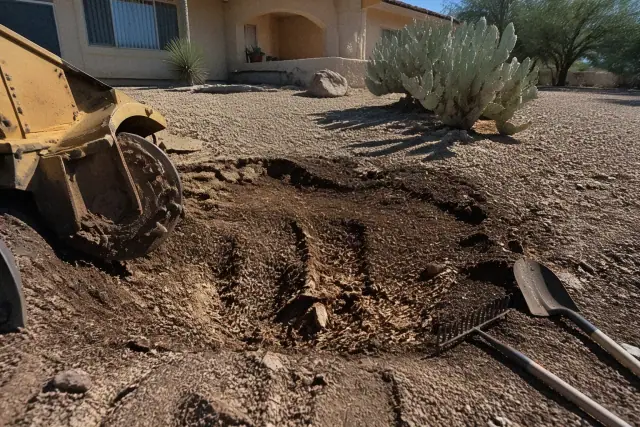
A stump grinder clearing a wooden stump in a Tucson, AZ residential yard with mulch and a stucco home in the background.

Once the trunk is removed, stump grinding can eliminate the remaining trip hazard and prepare the site for landscaping. Grinding depth is matched to whether the area will be replanted, sodded, or covered with hardscape.

Request Estimate

Landscape Recovery and Tree Planting

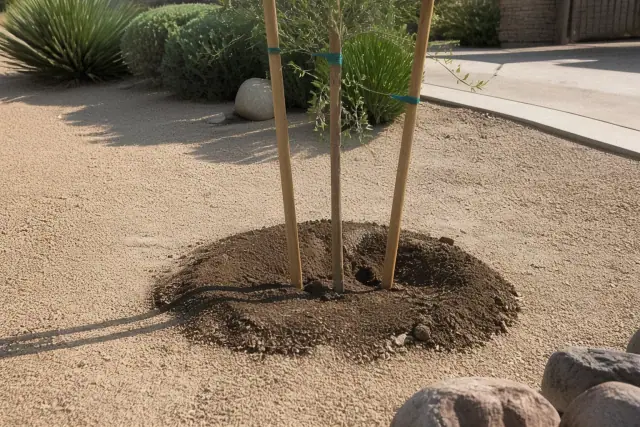
A newly planted sapling with wooden support stakes in decomposed granite soil during a cleanup in Tucson, AZ.

Cleanup can transition into replacement planting when removal leaves a gap in shade or privacy. Recommendations account for caliche layers, low rainfall averaging around 11 inches annually, drought adaptation, backfill needs, and room for a new root system to establish.

Request Estimate
Response Scenarios

Storm Cleanup for Different Conditions

Storm damage varies by property size, tree condition, species, access, and whether wood is resting on a structure. The cleanup plan can focus on a single residential hazard, a complex-wide debris field, recovery pruning, specialized palm or cactus handling, or documentation and disposal support.

Yard covered in storm debris and a downed tree trunk on a residential property in Tucson, AZ.

Residential Property Cleanup

Residential calls often combine one or two hazard trees with branch cleanup and requested stump grinding in a single visit. Mature mesquite and eucalyptus around Sam Hughes, Catalina Foothills, and the east side near Sabino Canyon require careful control near established homes.

  • Hazard-tree removal around roofs, carports, fences, and driveways
  • Broken branch and gutter-area debris clearing
  • Controlled rigging for compact residential drop zones
  • Stump grinding bundled with removal when requested
  • Final raking, blowing, and homeowner walk-through
Request Estimate
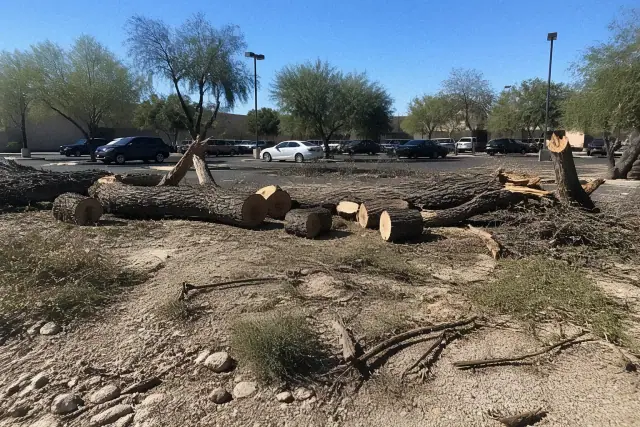
Contractors cleaning up fallen tree debris and storm damage in a commercial parking lot in Tucson, AZ.

Commercial and Multi-Property Cleanup

Commercial properties, HOA common areas, and multi-family complexes may need multi-day crews and multiple trucks after a major storm. Work is planned around tenant schedules, access restrictions, parking areas, and the need to keep debris from occupying drive lanes longer than necessary.

  • Parking lot canopy-tree removal
  • HOA common-area debris clearing
  • Retention-basin planting cleanup
  • Multiple-truck hauling for larger debris volumes
  • Scheduling around tenants and restricted access
Request Estimate
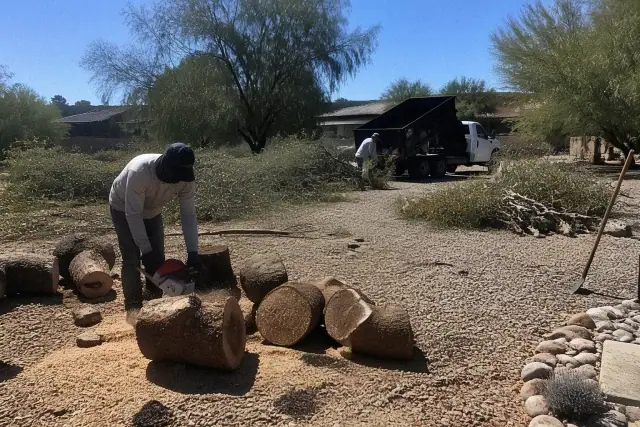
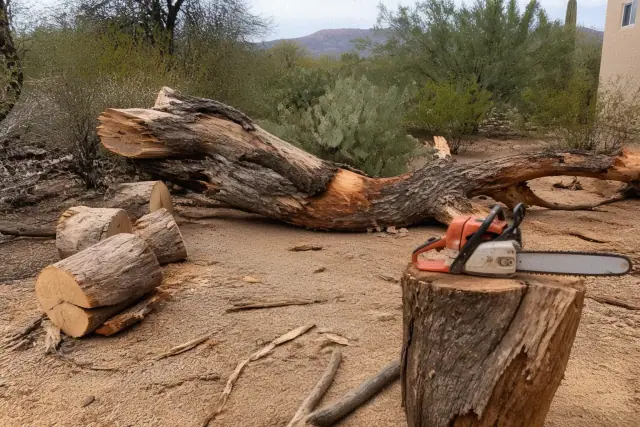
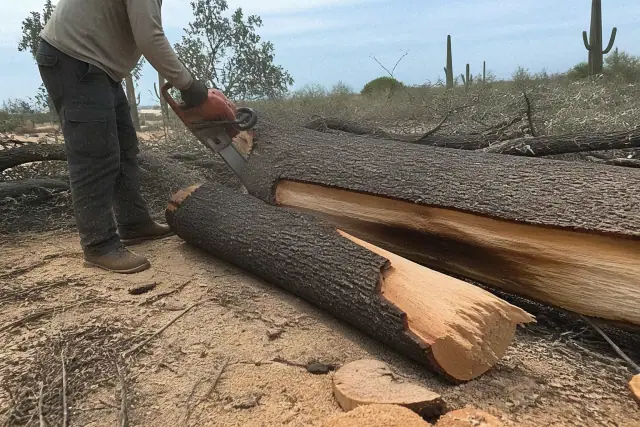
Contractor using a chainsaw to cut a downed tree trunk into logs in a sandy desert landscape in Tucson, AZ.

Standing Tree Recovery

Not every storm-damaged tree needs to be removed. Canopy loss, leader and scaffold condition, cracks in structural wood, lean angle, and root-plate movement are evaluated together before corrective pruning or removal is recommended.

  • Canopy-loss percentage review
  • Main leader and scaffold-branch inspection
  • Root-plate lift and crack evaluation
  • Included-bark and structural-wood checks
  • Corrective pruning for recoverable trees
Request Estimate
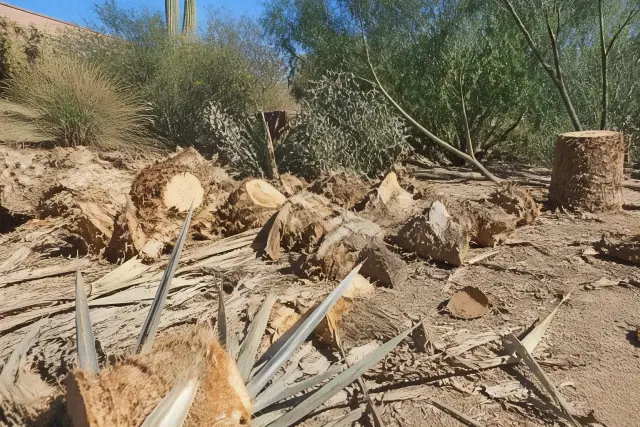
Workers clearing palm and cactus storm debris from a fallen tree trunk in Tucson, AZ.

Palm and Cactus Storm Cleanup

Wind can shred palm fronds and topple saguaros or barrel cacti after saturated soil releases shallow roots. A downed saguaro can weigh several hundred pounds because of its retained moisture, so removal and loading require deliberate handling.

  • Removal of shredded and hanging palm fronds
  • Crown-sensitive trimming that avoids over-pruning
  • Careful handling of toppled saguaros
  • Barrel cactus and loose-pad cleanup
  • Hauling suited to heavy, moisture-filled plant material
Request Estimate
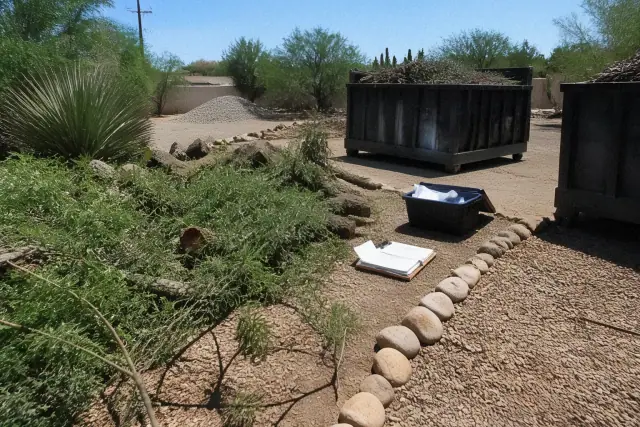
Organized storm debris, documentation logs, and haul-away containers at a cleanup site in Tucson, AZ.

Documentation and Disposal Support

Damage is photographed before and after removal, and itemized invoices describe the work performed for insurance discussions. Debris is hauled to approved green-waste or disposal facilities in line with Pima County Department of Environmental Quality requirements.

  • Before-and-after damage photographs
  • Itemized invoices describing completed work
  • Approved green-waste and disposal facilities
  • Wood chips sometimes available for mulch on request
  • Coordination-ready records for restoration contractors
Request Estimate
Matching the Response to the Risk

Choosing the Right Storm Cleanup Approach

The safest approach depends on whether the tree is standing or down, how its weight is supported, whether the root plate moved, and what lies inside the drop zone. An arborist assessment may lead to full removal, controlled limb reduction, corrective pruning, or monitoring, while the site plan determines the right combination of bucket access, rigging, chipping, hauling, and stump work.

ANSI-Based Safety Protocols

Pruning follows ANSI A300 standards, and aerial and rigging operations follow ANSI Z133 safety protocols. This framework shapes the hazard sweep, equipment setup, drop-zone control, cutting sequence, and crew communication.

Storm-Damage Assessment

A storm-damage assessment considers canopy loss, scaffold branches, included bark, cracks, lean angle, and root-plate movement instead of relying on appearance alone. Those findings help distinguish a tree that may recover from one that presents an ongoing failure risk.

Tucson-Ready Equipment

Bucket trucks, pulleys, rigging, chippers, stump grinders, and task-sized chainsaws are matched to the site and wood. The approach accounts for caliche-heavy soil and dense species such as mesquite, ironwood, and eucalyptus.

What Sets the Crew Apart

Why Choose Us for Storm Damage Cleanup?

Tucson Tree Service Co. combines tree-risk assessment with equipment for aerial access, controlled lowering, chipping, hauling, and stump work. Licensed and insured service includes a planned cutting sequence, cleanup expectations, and a final walk-through rather than an improvised removal.

Request a Hazard Assessment

Hanging or Split Limbs

A cracked branch above a driveway or a split leader can remain under tension after the storm appears to be over. Wind, movement, or a poorly placed cut may release that stored energy without warning, so the limb must be evaluated and lowered under control.

Lifted Root Plates and Leaning Trees

Saturated soil can loosen shallow roots and leave a mesquite, palo verde, or Aleppo pine leaning away from its original position. Visible soil heaving or root-plate cracking indicates instability that can worsen in the next wind event.

Trees Resting on Structures

A trunk or major limb on a roof, fence, carport, or vehicle can shift as its weight is cut away. Controlled top-down sectioning, lifting, and load redirection protect the supporting structure from a second impact during removal.

Scattered Storm Debris

Monsoon winds can distribute branches, brush, palm fronds, cactus pads, and dust across yards, gutters, access lanes, and parking areas. A fall 2025 storm system brought Southern Arizona one of its wettest days in over a year, followed by days of mud, limb, and debris clearing. A complete cleanup plan includes smaller material and hauling, not only the obvious trunk.

Hidden Structural Damage

Hairline trunk cracks, internal decay, and loosened root plates may not be visible from the ground after a significant wind event. An arborist consultation can identify structural capacity lost by a tree that still appears upright and undamaged.

Stumps and Exposed Roots

A remaining stump can leave a trip hazard, while large mesquite or eucalyptus roots may extend beyond the drip line and interfere with replacement planting. Grinding and root-site review prepare the area for replanting, sod, or planned hardscape.

How It Works

Our Storm Damage Cleanup Process

The process moves from safety assessment to a controlled removal plan, debris handling, site restoration, and final documentation. Each step accounts for power lines, stored mechanical energy, nearby structures, equipment access, and the condition of trees that remain standing.

01.

Complete a Site Hazard Sweep

The crew walks the full property before cutting to identify energized lines, unstable trunks, lifted root plates, spring-loaded branches, blocked access, and secondary damage that may not have prompted the original call.

02.

Coordinate Around Power Lines

If a tree is contacting Tucson Electric Power lines, work is coordinated before anyone touches the tree. The area stays clear while utility involvement and a safe work boundary are established.

03.

Build the Removal Plan

Lean, weight distribution, tension, compression, drop-zone limits, and equipment access determine the cutting sequence. The plan also separates trees that require removal from standing trees that may be stabilized through corrective pruning.

04.

Section and Lower the Tree

Crews cut from the top down and use bucket access, rigging, pulleys, cranes, or come-alongs as the site requires. Controlled lowering removes weight gradually and keeps wood from shifting into structures, vehicles, or occupied areas.

05.

Chip, Haul, and Restore the Ground

Brush is chipped when access allows, larger wood is loaded for hauling, and smaller debris is raked and blown from the work area. Requested stump grinding, disturbed-soil filling, and root-site review prepare the ground for normal use or replanting.

06.

Document and Walk the Site

Before-and-after photos and an itemized invoice record the completed work. A final walk-through confirms the cleanup result and identifies any standing trees, roots, or landscape areas that need monitoring or follow-up care.

Start With a Safe Assessment

Schedule a Storm Damage Assessment

Keep clear of any tree touching a power line, pressing against a structure, or holding a visibly tensioned limb. Photograph damage from a safe distance, then request an assessment so urgent hazards, cleanup needs, and recoverable trees can be identified before work begins.

Storm Cleanup Help

Storm Damage Cleanup FAQs

These answers cover immediate safety, Tucson storm conditions, cleanup timing, tree-recovery decisions, debris handling, stump work, documentation, and preparation for future wind events.

Call About Storm Damage

Stay clear of trees on power lines or leaning against a home, and photograph damage from several safe angles before anything is moved. Call an emergency arborist instead of cutting a trunk over 6 inches in diameter or any limb under visible tension. Damage affecting streets, parks, or public right-of-way should also be reported to the City of Tucson.

Yes. Tucson's first officially recorded tornado was an F2 with winds around 112 mph, resulting in 2 deaths and 8 injuries. Tornadoes remain rare in Southern Arizona compared with seasonal monsoon microbursts, haboobs, and straight-line winds.

Tree-related restoration removes fallen or hazardous trees, clears debris, grinds requested stumps, and restores the landscape work area. It is distinct from roof, siding, fence, or water-damage repair, although clearing the tree often gives a structural restoration contractor safe access to begin repairs.

Most residential tree-cleanup jobs take a half day to two full days, depending on tree count, size, debris volume, access, and whether stump grinding is included. Larger commercial or multi-property sites with several downed trees may take several days, especially after a citywide storm increases demand.

Tucson's desert basin, sparse ground cover, decomposed granite soils, and long dry stretches allow strong winds to lift large amounts of dust. Haboobs and severe thunderstorm outflows that move that dust can also snap limbs and topple shallow-rooted trees, so both conditions often appear across the same property.

Sometimes. A mesquite that lost 20 percent of its canopy may recover with corrective pruning if its main leader, scaffold branches, trunk, and root plate remain structurally sound. The decision depends on the pattern of damage rather than canopy loss alone.

Trees with more than 50 percent structural damage or a lean accompanied by visible root-plate heaving are flagged for removal. Included bark, cracks entering structural wood, and changes from the original lean angle also influence the risk decision.

Do not approach or touch the tree, nearby limbs, fencing, or other objects that may be energized. When Tucson Electric Power lines are involved, utility coordination occurs before tree work begins and the site boundary is kept clear.

Yes. The described service covers branch and debris cleanup around the tree, in gutters, and across the yard, along with chipping when access allows and hauling larger material. Debris goes to approved disposal or green-waste facilities under Pima County Department of Environmental Quality requirements.

Residential stump grinding typically reaches 4 to 6 inches below grade so the site can be replanted, sodded, or made safer to walk. A deeper grind may be appropriate when hardscape is planned, and large roots are identified if they could interfere with new tree establishment.

Yes. Cleanup includes shredded or hanging palm fronds, loose cactus pads, and toppled saguaros or barrel cacti. Palm crowns are trimmed without over-pruning, while heavy, moisture-filled cactus material is handled carefully during removal and hauling.

Before-and-after photographs and an itemized invoice document the tree work performed. The source cites national storm-damage averages of $3,000 to $7,000, with minor cleanup at $500 to $1,500 and major structural damage from a fallen tree at $5,000 to $20,000 or more; these are broad national figures, not a Tucson tree-service quote.

Regular pruning on a two- to three-year cycle can build stronger scaffold structure than leaving a tree unpruned for a decade. Crown thinning before summer storms can also help wind pass through a dense canopy, while inspection after sustained winds above 40 mph can reveal cracks or root movement that are easy to miss from the ground.