Grinding vs. Removal
Grinding reduces the stump to chips below soil level but leaves deeper roots in place. Removal excavates or pulls out the stump and primary root mass, causing more ground disturbance.
Yes. Tucson Tree Service Co. handles stump grinding and full stump removal across the Tucson metro every week, including older lots near Sam Hughes and new construction in the foothills. Grinding cuts the wood below the surface and leaves roots to decompose, while removal extracts the stump and root ball. The right method depends on what you plan to do with the ground next.
Grinding reduces the stump to chips below soil level but leaves deeper roots in place. Removal excavates or pulls out the stump and primary root mass, causing more ground disturbance.
Grinding is usually faster and less expensive because it requires less labor, equipment time, and cleanup. Removal costs more but clears substantially more of the root system.
Choose removal when the exact spot must support construction, regrading, or a replacement tree. For grass, gravel, desert landscaping, or a simply usable yard, grinding is usually enough.
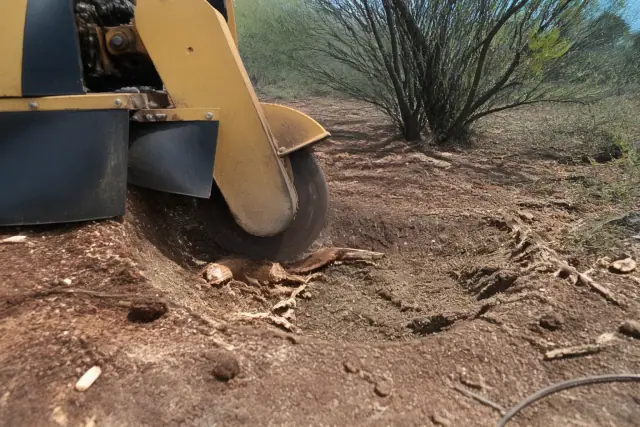
The cutting wheel reducing the visible stump to mulch-like chips while deeper roots remain in the soil. This image helps make the below-grade depth easy to understand.
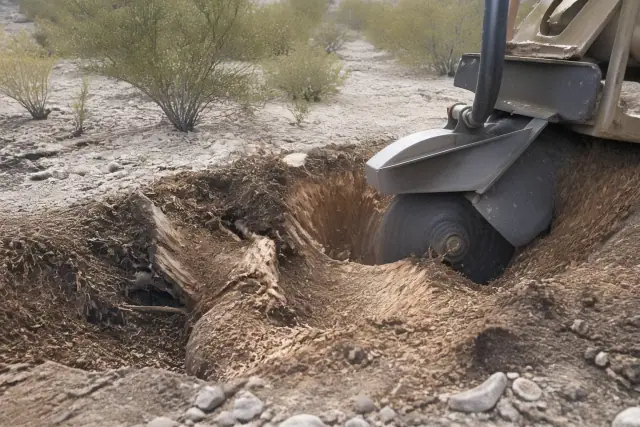
The stump and primary root mass pulled from an open hole before backfill and grading. Fine feeder roots may still remain beyond the excavation.
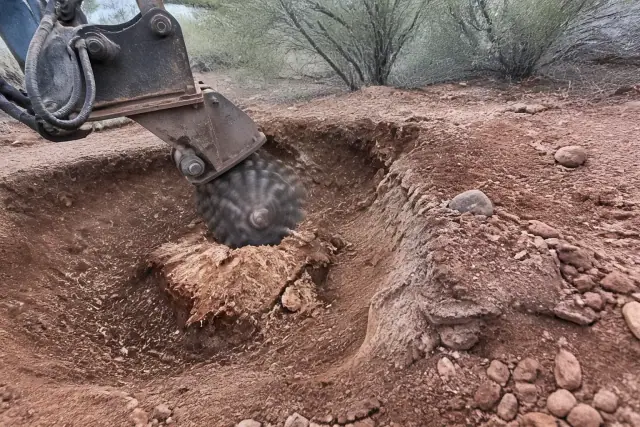
A Tucson stump near calcium carbonate hardpan, a block wall, and an irrigation line. These conditions affect equipment access and the risk of excavation.
Removal makes sense when a slab, patio, footing, grading plan, drainage project, plumbing run, or new irrigation work overlaps the stump area.
Caliche depth is a major local variable. Extraction from shallow hardpan can take twice as long as removal from looser desert loam and may require a mini excavator or backhoe.
Grinding can address surface roots within a few feet of the trunk, but deeper roots remain and decompose over several years. Even full removal usually leaves some distant or fine feeder roots.
After grinding, chips can be raked out or left as mulch, and the site is walkable within the hour. For a comparable stump, grinding costs roughly 40-60% less than full removal.
| Planned Use | Usually Choose | Why |
|---|---|---|
| Lawn, gravel, or desert landscaping | Stump grinding | It clears the visible stump with less soil disturbance. |
| Slab, patio, footing, or regrading | Stump removal | The build area needs a clear subgrade rather than decomposing wood below it. |
| New tree in the exact footprint | Stump removal | Removing the root ball makes room for the replacement root system. |
| Stump near a wall, irrigation, or utilities | Grinding after site assessment | Excavation can create more risk for nearby features. |
Grinding works from the stump's outer edge inward, leaving mulch-like chips and a surface that can be landscaped. Removal cuts exposed roots, then excavates or winches out the root ball before the hole is backfilled and graded. Grinding is the practical default unless the ground itself must be clear and buildable.
Stump diameter, wood hardness, root-flare width, and access shape a grinding job; root spread, soil type, and equipment access matter even more for removal. Mesquite and palo verde stumps may have deep taproots, while caliche can resist hand digging. Rocks must be cleared before grinding, and nearby irrigation, utility lines, or block walls call for a careful site assessment.
Tree removal does not automatically include stump grinding; the stump is quoted as a separate scope, though scheduling both together can avoid a second trip. After grinding, do not plant a new tree immediately in the exact spot because wood and remaining roots compete with the new root system; plant a few feet off-center or wait for the old stump to break down. If a permitted build footprint in Pima County overlaps the stump, full removal is the safer choice because decomposing organic material can be flagged beneath a slab.
Share the stump diameter, site access, nearby walls or irrigation, and what you plan to do with the space. A local crew can explain whether grinding or full removal fits the site and quote the stump separately from tree removal.